














Buying property in Dubai can offer rental income and long-term growth opportunities. However, a property’s asking price alone does not tell you how profitable it may be. You also need to consider rental income, service charges, acquisition costs and current market conditions.
So, how do you calculate property ROI in Dubai accurately?
The process starts with reliable data. First, compare similar properties in the same community. Next, review recent transactions and rental activity. Then, account for the costs of ownership before calculating your potential return.
In this guide, we explain how to calculate real estate ROI in Dubai in six practical steps. You will also learn how to use current market data to assess a property’s rental potential and make a more informed investment decision.
ROI stands for Return on Investment. It measures the return generated by an investment compared with the amount invested.
What Is ROI in Real Estate?
In real estate, ROI can help you assess the financial performance of a property. For rental properties, you can compare the income generated with the cost of purchasing and maintaining the asset.
However, there is an important difference between gross rental yield and net rental yield.
Gross rental yield measures annual rental income against the property purchase price. It does not account for expenses.
Net rental yield considers relevant rental expenses, such as annual service charges and maintenance costs. Therefore, it provides a more realistic view of recurring rental returns.
For a more complete investment analysis, you should also consider acquisition costs and financing expenses, where applicable.
Step 1: Check the Asking Price
Start by researching the asking price of comparable properties. You can use property portals such as Property Finder and Bayut to understand current market listings.
However, avoid comparing properties based on price alone. Instead, look for properties with similar characteristics.
Check the following factors:
- Location: Compare properties in the same building or community.
- Bedroom type: Match studios, one-bedroom apartments or larger units.
- Size: Compare properties with similar internal areas.
- View: Consider differences between community, park and waterfront views.
- Condition: Account for differences between renovated, furnished and unfurnished units.
These factors can influence both the asking price and potential rental income.
For example, two one-bedroom apartments in the same community may have different prices due to their size, floor level or condition. Therefore, a broader comparison may give you a misleading result.
Also, remember that asking prices are not confirmed transaction prices. Use them to understand current competition. Then, compare them with actual market transactions before estimating your property’s value.
Step 2: Check the Latest Dubai Property Market Data
Once you understand asking prices, review current market activity. This helps you assess whether your expected rental income reflects market conditions.
You can use DXB Interact to explore property transactions and rental market data.
Focus on these indicators:
- Recent sales transactions: Check the prices achieved by comparable properties.
- Rental transactions: Review recorded rental activity in the area.
- Average rental prices: Compare rents for similar units.
- Rental demand: Look at the level of rental activity and how it changes over time.
Next, compare these findings with the asking prices you collected in Step 1.
For instance, a property may have an attractive asking price. However, comparable units might achieve lower rents than expected. In that case, your projected return could be lower than your initial estimate.
On the other hand, strong rental activity may support further investigation. Still, past transactions do not guarantee future performance.
The goal is to estimate rental income using current evidence rather than assumptions.
Step 3: Check the Property Service Charge
Service charges are an important part of property investment costs in Dubai. They cover the management and maintenance of shared areas and facilities, subject to the building’s approved arrangements.
These charges reduce the income you retain from a rental property.
To check the applicable charges, open Dubai REST and access the Service Charge Index. Search for the relevant building and review the approved service charge information available.
Pay attention to the following:
- Approved annual service charge per square foot.
- The property’s chargeable area.
- The estimated annual service charge.
You can estimate the annual cost using this formula:
Annual Service Charge = Approved Rate per Sq. Ft. × Chargeable Area
For example, if the applicable rate is AED 15 per square foot and the chargeable area is 1,000 sq. ft., the estimated annual service charge is AED 15,000.
This is an illustrative calculation. Always verify the applicable rate and chargeable area for the specific property.
Once you have this figure, you can include it in your rental return calculation.
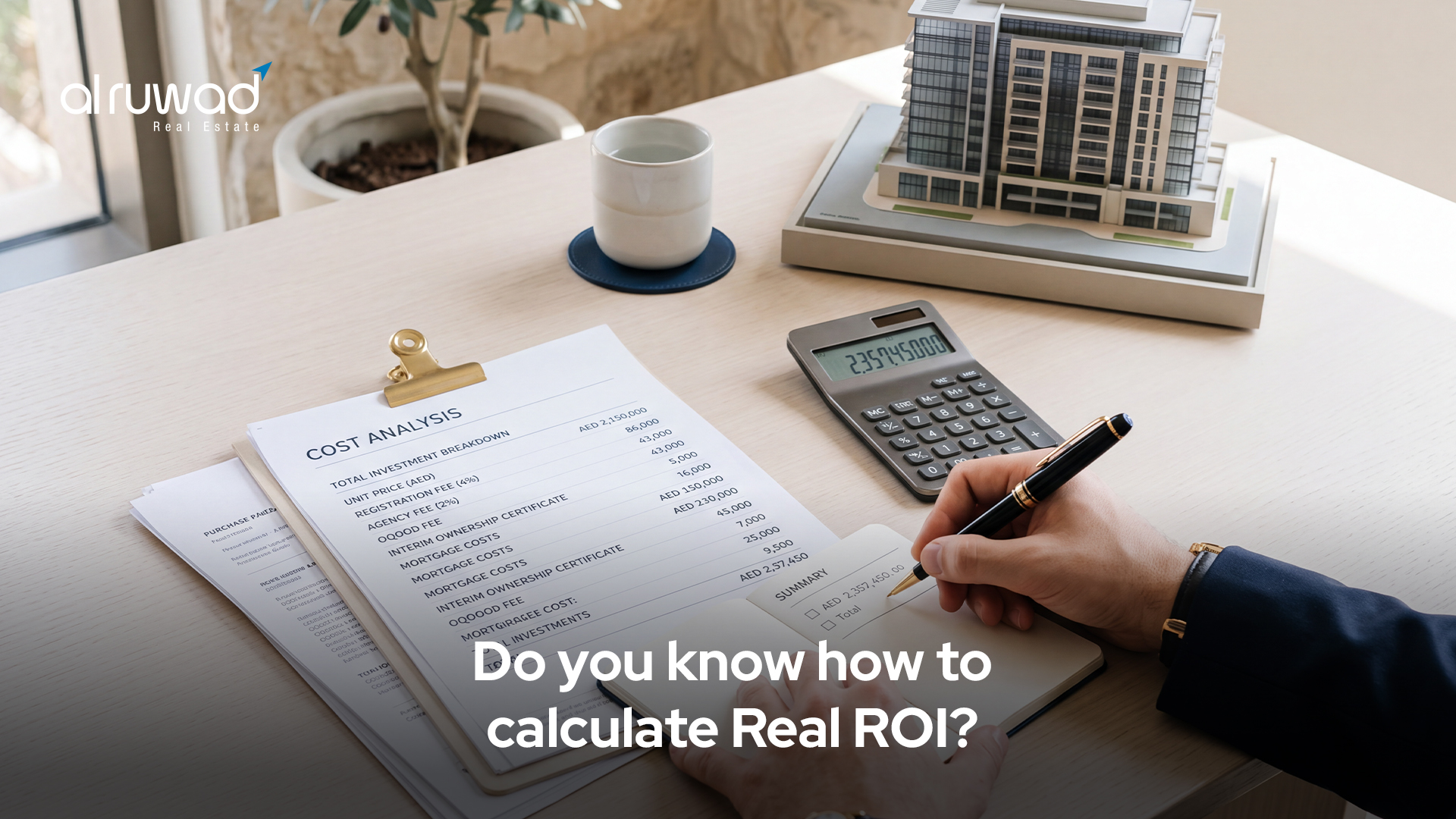
Step 4: Calculate Your Total Property Investment Cost
The purchase price is only one part of your property investment cost. You should also account for the additional expenses associated with acquiring the property.
These may include:
- Property purchase price.
- Dubai Land Department (DLD) registration fee.
- Trustee or registration-related charges, where applicable.
- Agency commission, where applicable.
- Developer or administrative fees, where applicable.
- Mortgage and valuation fees, if financing the purchase.
The exact costs depend on the property, transaction and payment method.
For example, consider a property purchased for AED 1,000,000. If the buyer incurs an illustrative AED 40,000 DLD fee and AED 20,000 in other acquisition costs, the total initial investment becomes AED 1,060,000.
This example assumes a 4% DLD fee and AED 20,000 in additional costs. Actual fees and exemptions should be verified for the transaction.
Including these expenses gives you a clearer picture of the capital required to purchase the property.
Step 5: Calculate Your Net Rental Return
Now you can estimate the property’s rental return using the figures you have collected.
First, establish the expected annual rent. Base this estimate on comparable rental transactions and current market conditions.
Next, subtract the annual service charge and other relevant recurring expenses.

A simplified formula for rental yield after service charges is:
Rental Yield After Service Charges (%) = (Annual Rent − Annual Service Charge) ÷ Property Purchase Price × 100
However, this formula does not include every ownership expense. It also uses the purchase price rather than the total acquisition cost.
For a more complete estimate, use:
Net Rental Yield (%) = (Annual Rent − Annual Operating Expenses) ÷ Total Acquisition Cost × 100
Annual operating expenses may include service charges, maintenance, property management fees and an allowance for vacancy, where relevant.
Example: Calculating Property Rental Yield
Suppose you purchase a Dubai apartment with the following figures:
- Property purchase price: AED 1,000,000
- Total acquisition cost: AED 1,060,000
- Expected annual rent: AED 80,000
- Annual service charges: AED 15,000
- Other annual operating expenses: AED 5,000
Your annual rental income after these expenses would be AED 60,000.
Therefore:
Net Rental Yield = (AED 80,000 − AED 20,000) ÷ AED 1,060,000 × 100
Net Rental Yield = 5.66% approximately
This example shows why the purchase price alone may not provide a complete picture. Acquisition costs and recurring expenses affect the return you receive.
If you use a mortgage, you should also assess financing costs and cash flow separately. Your actual cash-on-cash return may differ from the property’s net rental yield.
Step 6: Review Your Results Against the Current Market
Calculating ROI is only the beginning. You should also assess whether your assumptions are realistic.
Start by comparing your estimated rental yield with similar properties in the same community. Then, review recent transactions and rental activity to understand the market context.
Consider these questions:
- Is your expected rent supported by comparable rental transactions?
- Are service charges reducing your returns significantly?
- Have you included the main acquisition and operating costs?
- Could vacancy or unexpected maintenance affect your income?
- Does the property’s location support your investment objectives?
Next, test different scenarios. For example, calculate your return if annual rent falls by 5% or if the property remains vacant for one month.
These checks help you understand how changes in income and expenses may affect profitability.
Also, remember that rental yield does not measure total investment performance. Capital appreciation or depreciation, resale costs, taxes where applicable and financing can affect your overall return over time.
Common Mistakes to Avoid When Calculating Property ROI
Even a simple ROI calculation can be misleading if you use incomplete information. Keep these common mistakes in mind:
1. Using asking prices as confirmed values. Asking prices show what sellers want. Compare them with actual transactions wherever possible.
2. Ignoring acquisition costs. DLD fees and other purchase expenses increase the amount you invest.
3. Overlooking service charges. These expenses reduce the rental income you retain.
4. Assuming the property will always be occupied. Vacancy periods can reduce annual rental income.
5. Confusing gross and net rental yield. Gross yield excludes expenses, while net yield accounts for relevant operating costs.
6. Relying only on past performance. Historical prices and rental activity can inform your assessment, but they cannot guarantee future returns.
By checking these factors, you can build a more balanced view of a property’s potential.
Calculating Property ROI Before You Invest
Calculating property ROI in Dubai requires more than dividing annual rent by the purchase price. You need to understand current asking prices, recent transactions, rental demand, service charges and acquisition costs.
Start with reliable market data. Then, estimate your rental income and deduct the relevant expenses. Finally, compare your results with similar properties and test different scenarios.
This approach can help you assess investment opportunities with greater clarity. It also allows you to compare properties based on their potential financial performance rather than headline prices alone.
At Al Ruwad Real Estate, we believe informed property decisions start with a clear understanding of the market. Contact our team to discuss your investment objectives and explore Dubai properties that align with your goals.