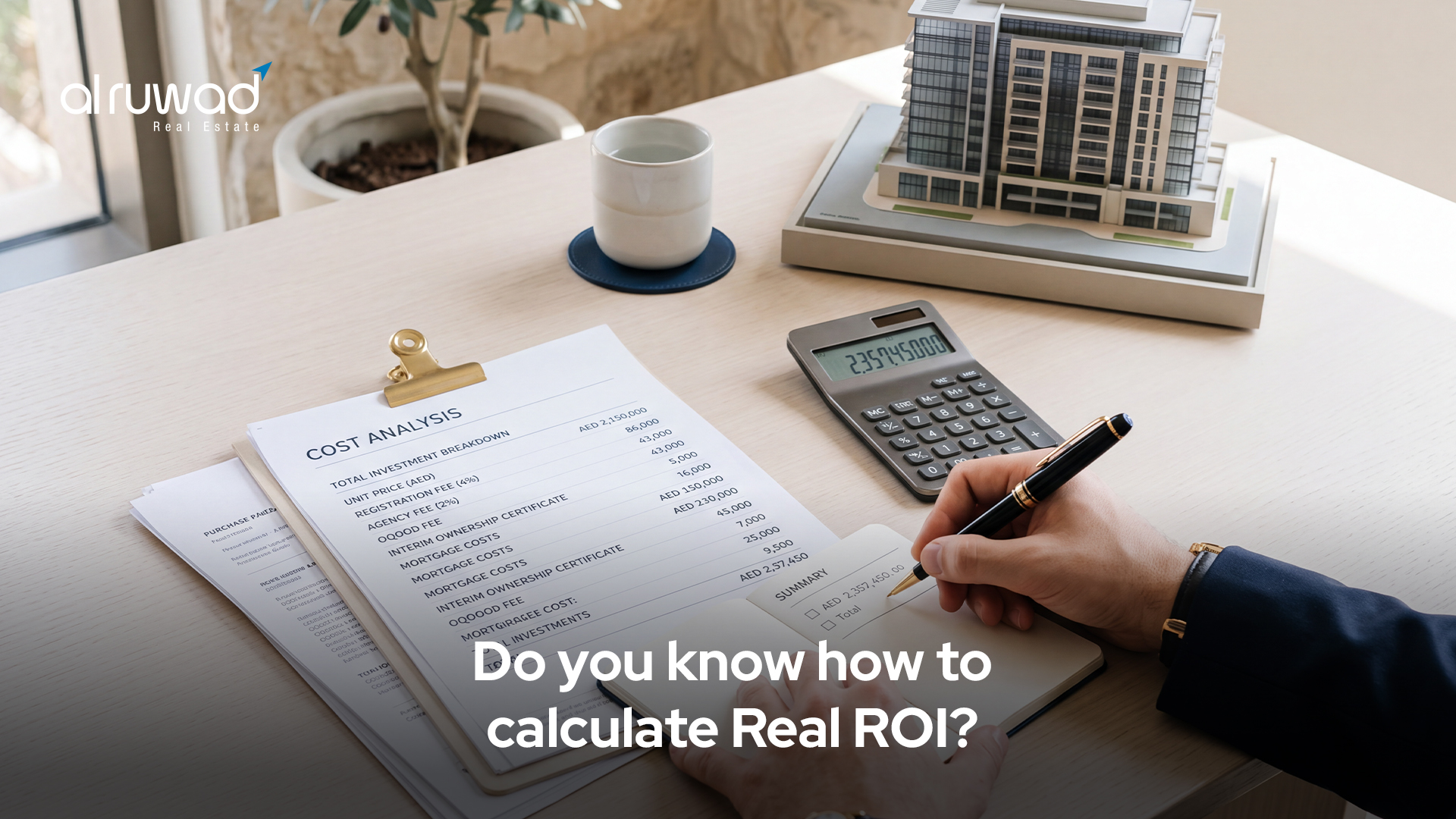














How much has your property investment really grown? The answer depends on how you calculate its returns.
Imagine purchasing a property in Dubai for AED 2 million. Three years later, its market value reaches AED 3 million. You have gained AED 1 million in property value. But is that the only figure you need to understand your investment’s performance?
Not quite.
Capital appreciation measures the total increase in value. Compound Annual Growth Rate (CAGR) shows the annualised compounded growth rate. Meanwhile, Equity Compound Annual Growth Rate (ECAGR) can offer another perspective by comparing the gain with the amount paid.
Each calculation answers a different question. Therefore, understanding these differences can help you evaluate real estate investment opportunities more effectively.
In this guide, we explain how to calculate property returns step by step, using a practical example.
What Are Property Investment Returns?
Property investment returns describe the financial gains or income associated with owning real estate. These can include increases in market value and rental income.
However, not every calculation measures the same thing.
For example, a property may appreciate by 50% over three years. Yet, that figure does not show its annualised growth rate. It also does not account for the investor’s payment schedule or ownership costs.
As a result, using the right calculation matters. Let’s start with capital appreciation.
How to Calculate Capital Appreciation
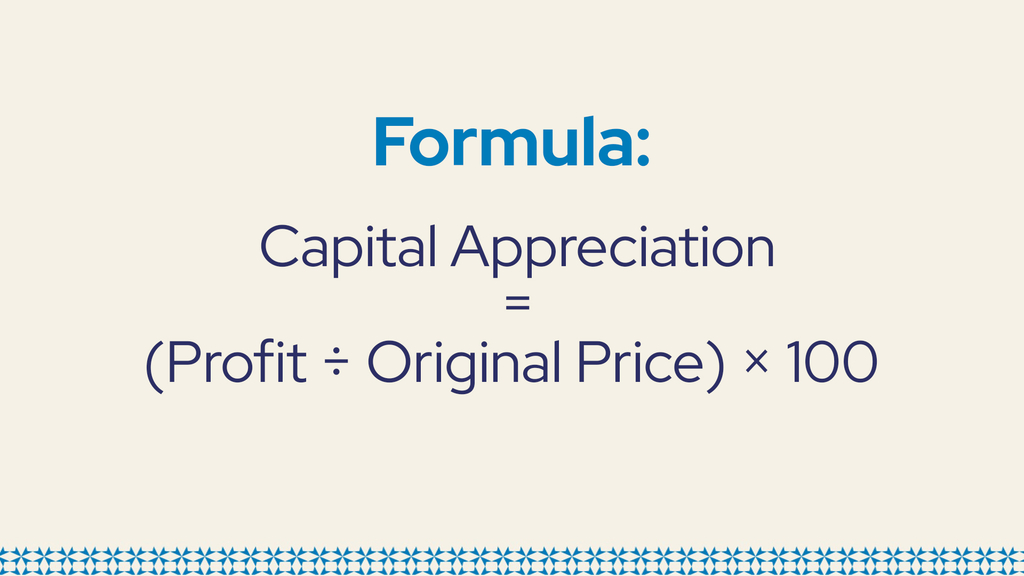
Capital appreciation measures the increase in a property’s market value compared with its original purchase price.
Suppose you purchase a Dubai property for AED 2 million. After three years, its market value rises to AED 3 million.
Here are the figures:
- Original purchase price: AED 2,000,000
- Current market value: AED 3,000,000
- Total gain: AED 1,000,000
- Holding period: 3 years
First, subtract the original purchase price from the current value.
Capital Gain = Current Value − Original Purchase Price
AED 3,000,000 − AED 2,000,000 = AED 1,000,000
Next, calculate the percentage increase.
Capital Appreciation (%) = (Capital Gain ÷ Original Purchase Price) × 100
(AED 1,000,000 ÷ AED 2,000,000) × 100 = 50%
Therefore, the property’s value has appreciated by 50% over three years.
This calculation provides a straightforward way to measure property value growth. However, it only shows the total increase. It does not tell you how quickly the property appreciated each year.
To understand that we need to calculate CAGR.
What Is CAGR in Dubai Real Estate?
CAGR stands for Compound Annual Growth Rate. It measures the annualised compounded growth rate between a property’s beginning and ending values.
Unlike capital appreciation, CAGR accounts for the holding period. This makes it useful when comparing property value growth across different timeframes.
For example, two properties may appreciate by different percentages over different periods. Comparing their total gains alone may not provide a fair picture of how quickly their values grew.
CAGR helps put those changes into an annualised format.
How to Calculate CAGR for a Property
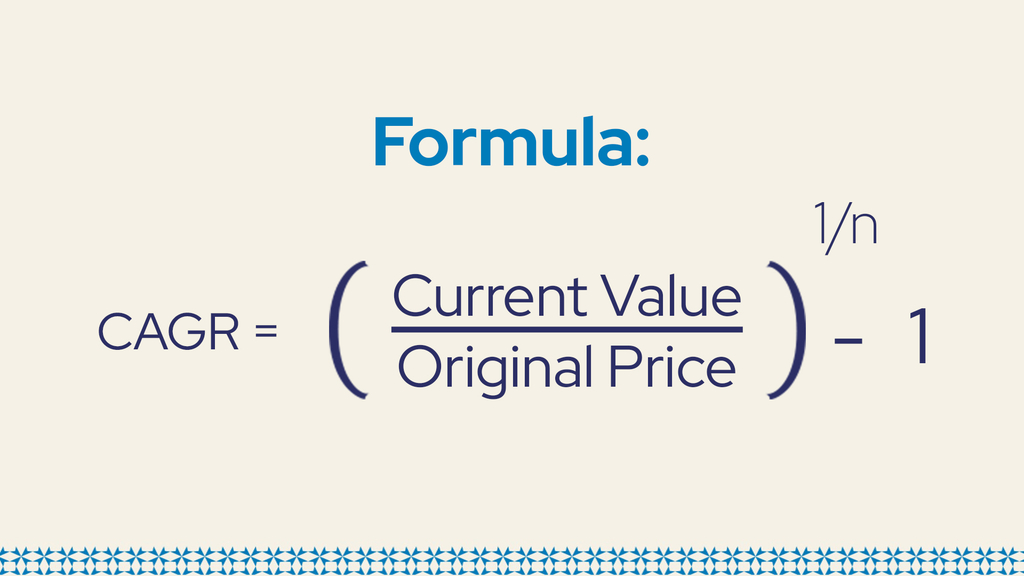
Use the following formula:
CAGR = [(Ending Value ÷ Beginning Value)^(1 ÷ Number of Years) − 1] × 100
Let’s return to our example:
- Beginning value: AED 2 million
- Ending value: AED 3 million
- Holding period: 3 years
Apply the figures:
CAGR = [(3 ÷ 2)^(1 ÷ 3) − 1] × 100
CAGR ≈ 14.5% per year
This means the property’s 50% total appreciation is equivalent to approximately 14.5% annualised compounded value growth over three years.
However, CAGR does not mean the property’s value increased by exactly 14.5% every year. Actual market movements can vary.
Also, this calculation measures property value growth. It does not include rental income, transaction costs, or financing expenses.
What Is ECAGR in Dubai Real Estate?
Now, consider a different situation.
You purchase an off-plan property for AED 2 million through a staged payment plan. Instead of paying the entire price upfront, you pay instalments over time.
Three years later, the property’s market value reaches AED 3 million. By then, you have paid 60% of the original purchase price.
Your contribution is:
AED 2,000,000 × 60% = AED 1,200,000
The property’s market value has increased by AED 1 million. But how does that gain compare with the AED 1.2 million you have paid?
An equity-based calculation provides another perspective.
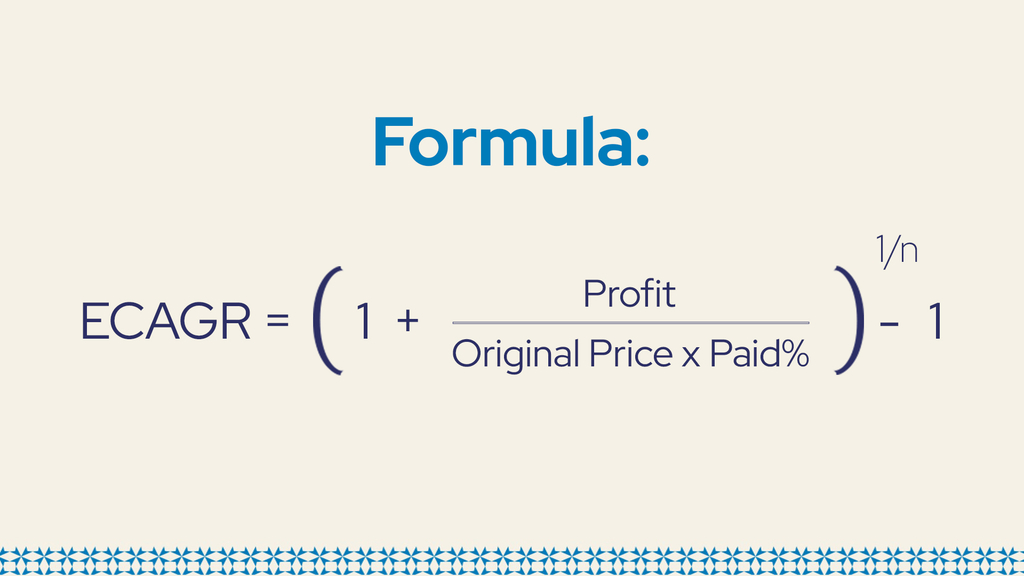
ECAGR stands for Equity Compound Annual Growth Rate. In this example, we use a simplified approach to annualise the gain relative to the amount paid.
It is important to understand that ECAGR is not a universally standardised property-return metric. The calculation below is illustrative. It does not represent a complete assessment of the investor’s actual return.
How to Calculate ECAGR
Let’s use the same property figures.
Original purchase price: AED 2 million
Current market value: AED 3 million
Total gain: AED 1 million
Amount paid: AED 1.2 million
Holding period: 3 years
First, Calculate the Gain Relative to the Amount Paid
Divide the capital appreciation by the amount paid.
Gain Relative to Amount Paid = Capital Appreciation ÷ Amount Paid
AED 1,000,000 ÷ AED 1,200,000 = 0.8333
Next, add one to the result.
1 + 0.8333 = 1.8333
Finally, annualise the result over three years.
Simplified ECAGR = [(1 + Capital Appreciation ÷ Amount Paid)^(1 ÷ Number of Years) − 1] × 100
Using our figures:
ECAGR = [(1.8333)^(1 ÷ 3) − 1] × 100
Simplified ECAGR ≈ 22.4% per year
This result illustrates the annualised growth factor produced by comparing the gain with the amount paid.
However, it is not directly comparable with CAGR. The calculation does not account for when instalments were paid, outstanding purchase payments, or transaction costs.
For a more complete assessment of returns on actual cash contributions, a cash-flow-based measure such as Internal Rate of Return (IRR) may be more appropriate.
Capital Appreciation vs CAGR vs ECAGR: What’s the Difference?
Now that we have calculated all three figures, let’s compare what they tell us.
1. Capital Appreciation: 50%
This measures the total increase in the property’s market value over three years. It answers the question: How much has the property gained?
2. CAGR: 14.5% per year
This expresses the change between the original and current property values as an annualised compounded growth rate. It answers the question: How quickly has the property’s value grown?
3. Simplified ECAGR: 22.4% per year
This illustrates the annualised growth factor when the gain is compared with the amount paid. It answers a different question: How does the gain compare with the contributed amount under this simplified calculation?
These percentages measure different things. Therefore, they should not be treated as interchangeable measures of investment performance.
Which Property Return Calculation Should You Use?
The right calculation depends on your investment objective.
Use capital appreciation when you want to measure the total increase in property value. It provides a simple comparison between the original purchase price and the current market value.
Use CAGR when you want to understand annualised property value growth. It can help you compare properties held for different periods, provided you use consistent valuation dates and comparable figures.
An equity-based calculation can help illustrate how the gain compares with the amount contributed. This may be relevant when reviewing an off-plan property with a staged payment plan.
However, if you want to assess the actual return on your cash contributions, consider the timing of payments and all relevant cash flows. IRR may be more suitable for this purpose.
You should also account for rental income, service charges, transaction costs, and financing expenses when assessing the overall performance of a property investment.
At Al Ruwad Real Estate, we believe informed decisions begin with clear information and a thorough understanding of the opportunity. Explore property investment opportunities in Dubai with Al Ruwad Real Estate.